
Steel vs Aluminum Truck Toolboxes: Which One Should You Choose?
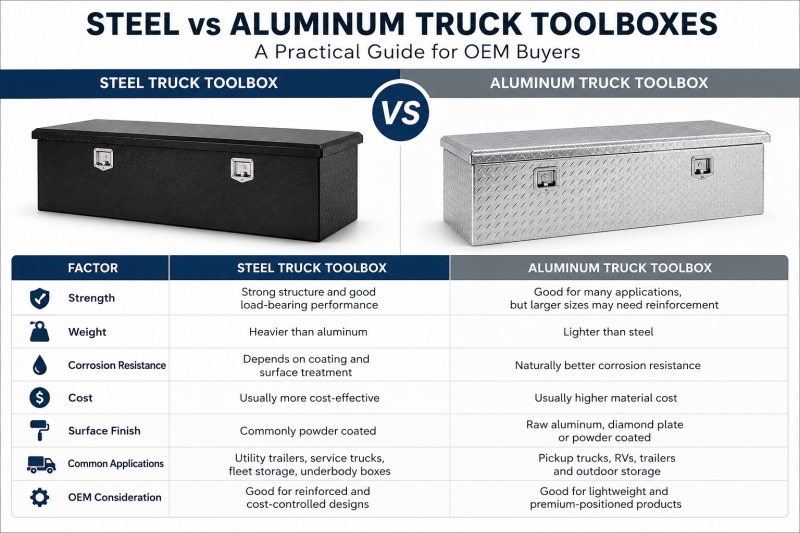
Steel vs Aluminum Truck Toolboxes: A Practical Guide for OEM Buyers
When developing a truck toolbox, underbody box or trailer storage box, material selection is one of the first decisions buyers need to make. Steel and aluminum are both widely used for truck toolboxes, but they are suitable for different applications, cost targets and market requirements.
For OEM buyers, private-label brands, trailer manufacturers and fleet storage projects, the right choice depends on strength, weight, corrosion resistance, surface finish, budget and the vehicle or trailer where the toolbox will be used.
1. Why Material Selection Matters
The material of a truck toolbox affects more than appearance. It can influence product weight, loading strength, outdoor durability, production cost, packaging method and shipping cost.
For trailer manufacturers, distributors, fleet operators and private-label buyers, choosing the right material helps control product performance and market positioning from the beginning of the project.
2. Steel Truck Toolboxes: Strength and Cost Control
Steel truck toolboxes are commonly selected when structural strength and cost control are important. Steel offers good load-bearing performance and is suitable for many commercial vehicle, utility trailer, service truck and fleet storage applications.
Steel is often used for underbody boxes, trailer boxes and storage boxes that require a strong structure, reinforced mounting points or stable batch production cost.
For standard commercial use, 1.2 mm steel may be suitable. For heavier-duty applications, buyers may consider 1.5 mm steel, reinforced panels or additional internal support structure.
Steel toolboxes are usually powder coated to improve surface appearance and outdoor protection. Black powder coating, textured coating and custom colors can be selected based on the buyer’s brand and target market.
3. Aluminum Truck Toolboxes: Lightweight and Corrosion Resistance
Aluminum truck toolboxes are often selected when lighter weight and corrosion resistance are important. Compared with steel, aluminum can help reduce product weight, which may be useful for trailers, pickup trucks, RVs and outdoor storage applications.
Aluminum is also a good option for markets where buyers prefer lightweight storage products or where corrosion resistance is a key selling point.
However, aluminum material cost is usually higher than steel. For larger toolboxes or heavy-duty applications, buyers should also review the structure, hinge design, lock system and reinforcement method before confirming the specification.
4. Surface Finish and Outdoor Durability
Surface finish is an important part of toolbox durability and appearance.
Steel truck toolboxes are usually powder coated to improve corrosion protection and create a clean, consistent finish. Buyers can choose black powder coating, textured coating or custom colors depending on brand and market requirements.
For aluminum toolboxes, buyers may choose raw aluminum surface, diamond plate aluminum, powder coating or other surface treatment depending on the product design.
Surface finish should be confirmed together with the application environment, because outdoor use, transportation vibration, road conditions and long-term exposure can all affect product performance.
5. Steel vs Aluminum Truck Toolbox: Quick Comparison
| Factor | Steel Truck Toolbox | Aluminum Truck Toolbox |
|---|---|---|
| Strength | Strong structure and good load-bearing performance | Good for many applications, but larger sizes may need reinforcement |
| Weight | Heavier than aluminum | Lighter than steel |
| Corrosion Resistance | Depends on coating and surface treatment | Naturally better corrosion resistance |
| Cost | Usually more cost-effective | Usually higher material cost |
| Surface Finish | Commonly powder coated | Raw aluminum, diamond plate or powder coated |
| Common Applications | Utility trailers, service trucks, fleet storage, underbody boxes | Pickup trucks, RVs, trailers and outdoor storage |
| OEM Consideration | Good for reinforced and cost-controlled designs | Good for lightweight and premium-positioned products |
6. Which Material Is Better for Your Project?
There is no single best material for every truck toolbox project. The better choice depends on how the product will be used.
Steel may be a better choice if the project requires strength, reinforced structure, stable production cost and commercial-use durability.
Aluminum may be a better choice if the project requires lighter weight, corrosion resistance and a more premium appearance.
For OEM projects, buyers should also consider mounting position, loading requirements, target market, packaging method and expected order quantity.
7. OEM Buyers Should Compare the Full Specification
Material is only one part of the quotation. Buyers should also compare product thickness, lock type, hinge structure, sealing method, welding quality, surface finish, packaging and batch consistency.
A lower unit price may not always mean a better product if the thickness, hardware, surface treatment or structure is different.
Before confirming an OEM truck toolbox order, buyers should review the complete specification instead of comparing material alone.
Need Help Choosing the Right Truck Toolbox Material?
If you are developing an OEM truck toolbox, trailer storage box or custom metal storage product, Jiashan Chenchuang can help review your application, target size, material requirement and order quantity.
We manufacture steel truck toolboxes, aluminum truck toolboxes and custom metal storage boxes for trailers, trucks, service vehicles and fleet applications.
Please send us your drawings, dimensions, sample photos or project requirements for quotation support.


 Send Email
 15057466174
 Ronan Meng